
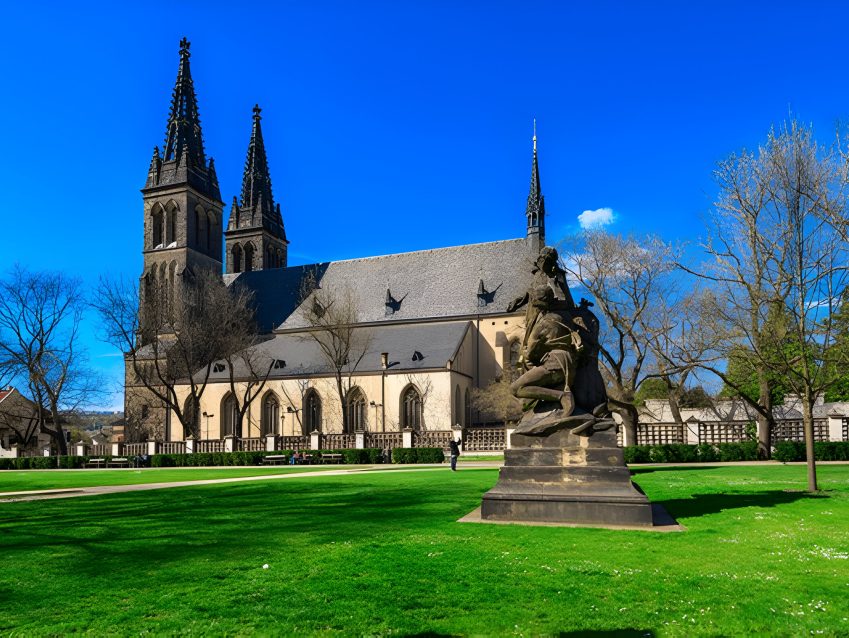
Whether you are a history enthusiast or simply looking for a relaxing stroll, the Vyšehrad Fortress should be on your itinerary. This green oasis boasts massive fortification walls, a distinctive church with a unique cemetery, and spectacular views of the city.
Vyšehrad is a historic site located on a rocky hill overlooking the Vltava River. Over the centuries, it has undergone numerous transformations, evolving from a royal castle in the 10th century to a Baroque fortress in the 17th and 18th centuries. Eventually, it became a national symbol and the final resting place of important Czech patriots during the National Revival in the 19th and early 20th centuries.
The mighty rock, towering high above the Vltava River, attracted settlement in the ancient times and became the subject of many legends. What we do know now is that Vratislav II (the first Czech king, from the same Přemyslid dynasty as St Wenceslas) built a palace here in the late 11th century, which is connected with a real-life story of sibling rivalry. Vratislav was frustrated by the appointment of his brother Jaromír as Bishop of Prague. In a strategic move, he established a separate church at Vyšehrad that would answer to the Pope rather than the bishop. Perhaps this partly explains Vyšehrad’s unique place in the Czech imagination throughout its long history. Some historians and patriots even believed that it predated Prague Castle, which was later proved wrong.
You can recognize Vyšehrad from afar thanks to the sleek dark spires of St Peter and Paul’s Basilica, which houses one of the country’s unusual church interiors. This is mainly due to its rare richly painted Art-Nouveau/ Neo-Gothic interior, mostly created in the 19th century. The original floral and other intricate decoration and stone carvings make it a real treat, offering a visually appealing blend of ornamental delights, piety and patriotism. These elements add elegance and sophistication to the basilica’s already impressive Neo-Gothic architecture (1903). It is remarkable that its history dates back to the 11th century, with Romanesque, Gothic and even Baroque remains hidden within the current structure. This church is one of the few in Prague that charge for entry, but it is also one of the most beautiful and unusual ones you will find.
Another popular destination for visitors to Vyšehrad is the Vyšehrad Cemetery, where over six hundred notable Czech figures are buried. Renowned artists, writers, composers, and politicians (19th/20th c.) were selected for this honour, including the composers Bedřich Smetana and Antonín Dvořák. Visitors can marvel at the beauty of tombstones, statues, and arches adorned with murals.
History enthusiasts will be able to explore the Baroque fortifications and casemates in more detail to gain insight into the fortress’s military past. This includes part of the casemates that were used as air-raid shelters during WW2 (exteriors free, interiors paid). The casemates also house some original sandstone sculptures from Charles Bridge, protecting them from further damage.
There are many other buildings within the fortification walls of Vyšehrad. The 10th-century St. Martin’s Rotunda is for travellers who appreciate simple, but rare Romanesque architecture. However, the interior has been significantly renovated, with 19th-century colourful murals adorning the interior.This ancient rotunda is one of the oldest buildings in the Czech Republic (there is a paid entry fee; it is open only occasionally, or accessible for free during regular church services).
Those interested in miracles, mysteries and legends may wish to look at the remains of the Devil’s Column on the way to the basilica. It is said to have been brought there by the devil overnight from Italy, only to be thrown against the church roof. The devil supposedly became enraged after losing a bet with a priest. You will find the column opposite the buildings belonging to the Vysehrad Chapter, and also a painting depicting the legend inside St Peter and Paul’s Basilica.
Vyšehrad also provides breath-taking views of the city and its vineyards, making it an ideal setting for photography, relaxation and dining in fresh air. Come and experience the charm and tranquility of Vysehrad at first hand! Although it has become more popular with tourists recently, it remains a peaceful retreat for locals, including families with children, who can play in the playground. Friends come for a little picnic and couples sip wine while taking in the romantic views. It is less busy with tourists in the evening, but charming at any time of the day.
Vyšehrad is easily accessible by public transport. Unless you would prefer an uphill climb from the river (Výtoň), simply take Metro C line from the centre. It is only about five minutes from Wenceslas Square (Muzeum to Vyšehrad), with a ten-minute flat walk to reach your destination. If you do not mind climbing the steps downhill afterwards, you can easily go for a pleasant riverside walk, or go to the centre by tram.