
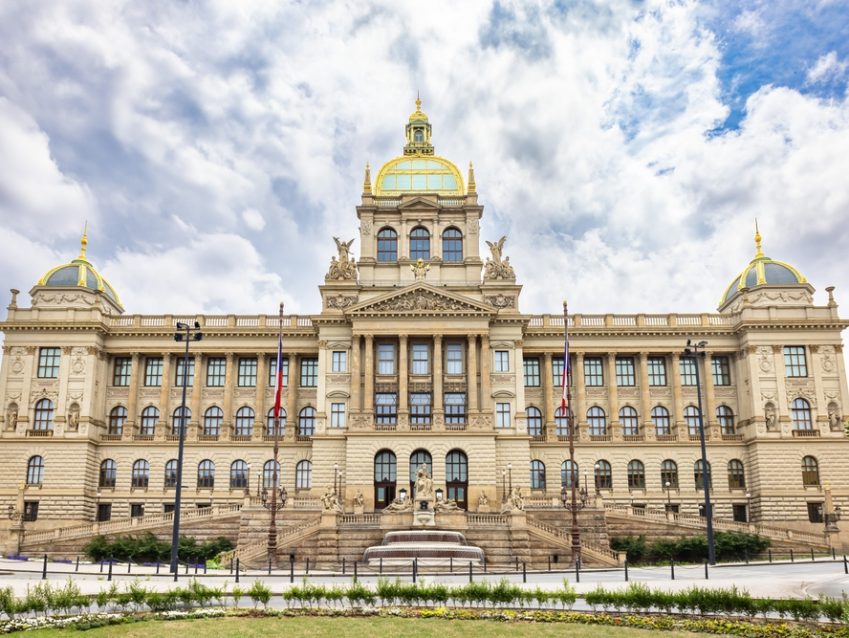
The National Museum, whose main historical building (1891) is located at the upper end of Wenceslas Square, is a monumental institution of culture and history in Prague.
The construction of this impressive large building was a significant achievement of the Czech National Revival Movement. Proud Czech intellectuals as well as ordinary people sought to reinvigorate Czech culture, language and identity in the 19th century, during the rule of the Austro-Hungarian Empire. Funding for the museum came from private donations, notably from prominent Czech families, particularly those with ties to the noble class.The building’s facade also bears the names of significant Czech patriots and other prominent figures, serving as a testament to its commitment to honoring the nation’s heritage and its role models.
Despite its construction in the monumental Neo-Renaissance style, it is not an old-fashioned impractical building, including its interior layout. Josef Schulz, a well-known figure in his field, drew inspiration from international projects, having worked on the National Theatre and Rudolfinum. Even some sculptors and painters who had previously worked there were responsible for the stunning interior decoration of the historical building.The most beautiful interior feature of the museum is perhaps its complex system of monumental staircases with landings in the grand entrance hall, part of which is visible without buying entrance tickets. The first-floor elevated pantheon hall is decorated with sculptures of significant figures from Czech history, the museum’s founders, and its patrons. As a result, the gallery also boasts a collection of Czech sculpture dating back to the 19th and early 20th centuries. Visitors can also enjoy a variety of extraordinary paintings and beautiful marble cladding.
The twentieth century took its toll on the monumental museum building – in May 1945 it was hit by an aerial bomb, while in August 1968 it was damaged by gunfire from the occupying Soviet forces (some light spots were actually left on the columns as a reminder). Moreover, during the Communist era, it was affected by the construction of the Metro and the north-south highway, when the busy road cut off the building from the rest of the square and a significant portion of the green park area was removed. Needless to say that the building itself was neglected for a many years during that period.
Fortunately, the museum has recently undergone another extensive and costly reconstruction. One of its highlights now is also the newly opened viewing platform in the cupola, providing breath-taking panoramic views. This addition enables guests to experience both the historical significance of the museum and the lively atmosphere of the square below.
Visitors will also be able to appreciate the newly renovated elegant water fountain, which adds to the area’s aesthetic charm. The design features two Czech rivers, the Vltava (Moldau) and the Elbe, with three women symbolising the three regions of the country. Bohemia, Moravia and Silesia, along with sculptures entitled History, Literature, and Natural Sciences.
The building’s design emphasises the grandeur of Czech heritage, history and cultural pride, while the adjacent New Building of the National Museum creates a stark contrast and reminds us of the country’s Communist past, when it was used as the Federal Assembly building by the Communist Party. Its upper part, constructed on top of an older stock exchange building, is a well-known example of heavy modern architecture, which some people might call brutalist (1979). Following the Velvet Revolution the building also housed Radio Free Europe until 2009. It is now part of the National Museum, with a stronger emphasis on modern history. (In addition, there is a museum for children in the modern building.) In fact, its 20th century history exhibitions are among the most popular in the entire museum, so it is recommended that you do not miss the New Building, even though it is not as stunning as the Historical Building. Please note that both buildings have permanent exhibitions, which are included in the same ticket. As a bonus, visitors will be able to walk through an underground passageway connecting the two buildings, with important milestones of Czech history being projected on its walls in a captivating visual show.
In the historical building visitors are welcome to appreciate exhibits focusing primarily on natural history, such as collections of zoology, paleontology, anthropology, and geology, as well as temporary exhibitions. The museum’s most popular exhibits include its exquisite mineral and stone collections, as well as its impressive displays of ancient skeletons, including those of a mammoth and a whale. The museum also regularly hosts unique temporary exhibitions, including those on photography, the environment, arts and crafts, and world history.
The National Museum in Prague is a cornerstone of Czech natural sciences, history, culture and heritage, and is situated on one of the largest squares in the country, where many fundamental events have taken place. Given the significant events, including fighting, marches, protests, demonstrations and revolutions, the museum and the square will forever be associated with the nation’s patriotic struggle for identity and democracy.