
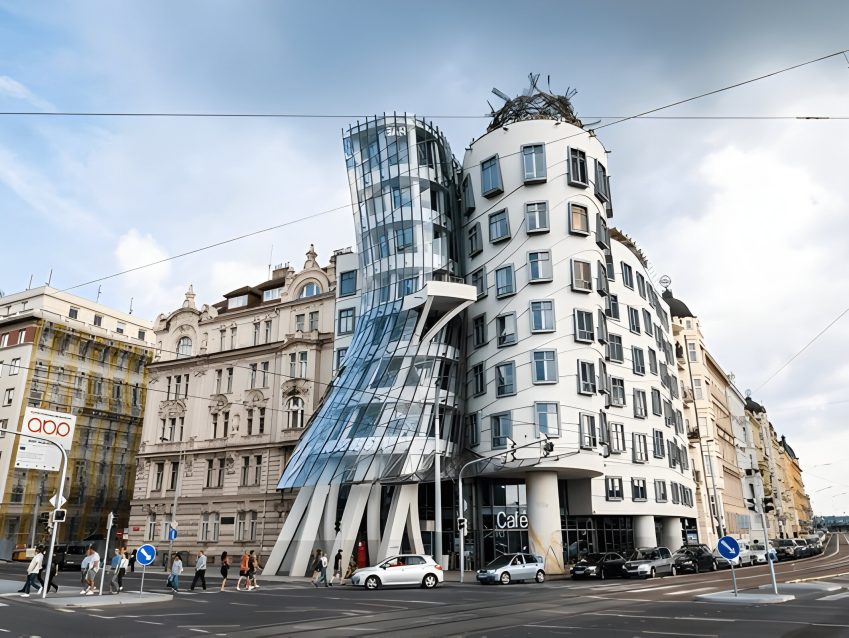
Most travellers probably wish to see the Dancing House because of its uniquely vibrant look and the opportunity to take amusing photographs while standing in front of it. It is also a feast for the eyes when you see it glowing in the dark, like a futuristic ship. One of the great places to go to, especially when other places are closed at night.
Many people call the Dancing House “Ginger and Fred” because its concept was inspired by the dance skills of the famous film dance duo. The stone tower is said to symbolize Fred Astaire, and the glass “wilder” tower represents his female partner, Ginger Rogers. This film connotation emerged during the creative process in the architectural studio. The design was primarily created by Frank Gehry (Canadian-American) and Vlado Milunić (Croatian-Czech) and finished in 1996, winning awards soon afterwards.
The dynamic shape of the Dancing House creates a striking contrast with the surrounding older architecture (19 and 20th c.) on the Rašín Embankment. It is indeed an unusual modern building, ahead of its time. A prime example of deconstructivist architecture, it uses fragmented dynamic elements that typically break traditional rules of symmetry to make buildings look like they are moving or falling apart. The renowned Czech-British high-tech architect Eva Jiřičná later designed a substantial portion of the interior, skillfully handling the building’s asymmetric shape in an elegant manner, creating a unique atmosphere of clean lines and airiness, completely in harmony with Milunić and Gehry’s design.
Although many Praguers initially resented the futuristic look of “Ginger and Fred,” it is now one of Prague’s most iconic landmarks. It may also serve as a visual metaphor for movement and change, especially significant since there had been no buildings like it in Prague until then.
Moreover, the location shares a personal connection with Václav Havel, the first democratic president after forty-one years of Communist rule in the country (1948-1989). Havel supported the building project as a symbol of democracy and progress following the Velvet Revolution in 1989, a period characterized by movement and unprecedented changes.
In fact, the entire area is connected to Havel‘s family and childhood, not just his support during his presidency. On the site of the Dancing House, there used to be a block of flats swept away by the fateful allied bombing in 1945. Havel’s family were living in another building just around the corner, which still stands. Later Havel and Milunić saw the site being empty for years after the bombing, and kept dreaming about creating something special there one day, when better times would finally come. Havel’s Family survived and did not leave the country like many other rich and influential families after the Communist takeover in 1948. Not surprisingly, their living conditions significantly changed. Labelled as a “Capitalist bourgeoisie family,” they were blacklisted and stripped of almost all their property, eventually left with only one flat in the same building. Later, when Havel, a well-known dissident playwright and human rights activist, began playing a more active role in the anti-Communist movement, the flat flat was frequently surveilled by secret agents. When you look at the plaque on the facade devoted to Václav Havel (2000/II Rasin Embankment), you can imagine them watching his every move.
The Dancing House is now a multi-purpose building, rather than the cultural hub that Havel envisioned. While there is a gallery where cultural events are occasionally held, most of the building is office space.This is not surprising, considering that its initial sponsor was a Dutch insurance company (Nationale-Nederlanden, now known as the ING Group). Fortunately, other areas are accessible to the general public. The Glass Bar (access to the terrace) and the Ginger & Fred restaurant (inside) both offer panoramic views, as does the unique hotel, Dancing House Hotel.
The iconic exterior of the Dancing House is a must-see, and it is particularly impressive at night. If you are interested in modern architecture and want to see it up close, we recommend exploring the interiors too, especially the terrace. To do so, you need to make a reservation on the Glass Bar website and pay an entrance fee. Alternatively, if you would prefer views of the New Town without paying, you can visit the Maj terrace (Fly Vista restaurant/cafe). Visitors are only allowed on the terrace if they buy a drink. As for the views, you can see more highlights up close. You are further from the river, but closer to the Old Town and Prague Castle.
The Dancing House is easily accessible by public transport. Please refer to the PID app for details. If you have more time, it is also possible to walk there from the National Theatre along the river, which is a very pleasant route. Nearby stops include Jiráskovo náměstí (Jirasek Square), which is the closest stop, and Karlovo náměstí (Charles Square). The latter is ideal if you want to explore the free WWII crypt (Anthropoid Operation crypt) on the way. Although the proximity of the Dancing House and the crypt is purely coincidental, it is fitting and convenient for WWII enthusiasts. From the ashes of war to the hopes of post-Communist society, the Dancing House has become a symbol of the country’s survival, evolution and creativity.