
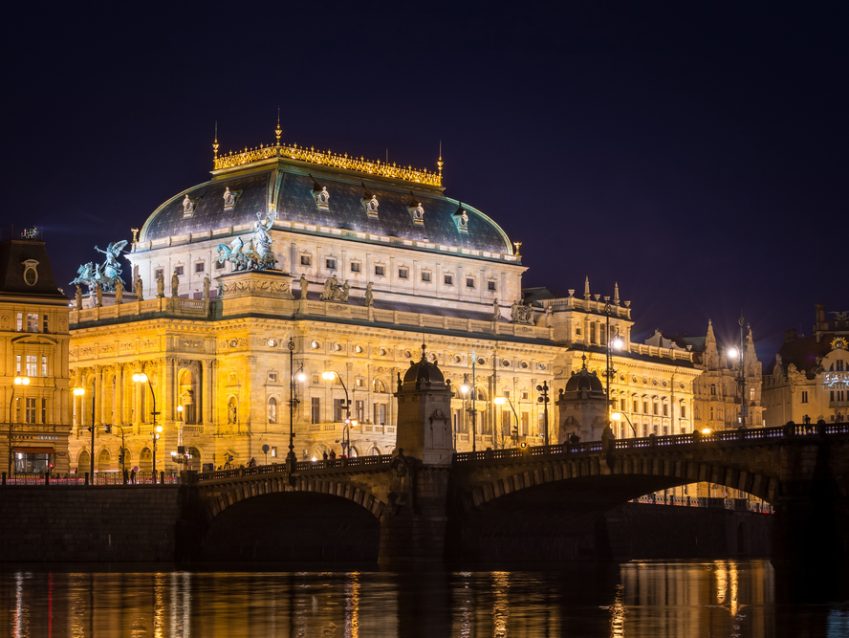
The National Theatre in Prague stands as one of the most iconic cultural landmarks in the Czech Republic, embodying the nation’s historical struggles under the Austro-Hungarian Empire. At that time, Czechs did not have a permanent theatre in which to watch performances in their own language, not German.
Located on the banks of the Vltava River, the theatre complex consists of two main structures: the elegant 19th-century main building: The Historical Building of the National Theatre (Historická budova Národního divadla) and the modern New Stage (Nová scéna) from the Communist era (1980s). If you want to see the breathtakingly elegant interiors, you know which building to choose.
The history of the National Theatre is deeply intertwined with the Czech National Revival, a 19th-century movement that sought to promote the Czech language, culture, and identity. The idea of a national theatre became a symbol of Czech aspirations for cultural and political autonomy, with even ordinary people who could barely afford food donating money for the theatre to be built. Tragically, just two months after its opening in 1881, the theatre was devastated by a major fire, during which most of the theatre burnt down. The disaster was a profound blow to the nation, but it united the proud Czech patriots in yet another attempt to build the symbol of Czech national pride. After another massive fundraising campaign, the theatre reopened after two years.
Designed by renowned Czech architects, the theatre is a grand Neo-Renaissance structure with intricate sculptures and decorative elements. Its most iconic feature is the golden roof, adorned with a crown and shimmering in the sunlight. The crown is a proud representation of the theatre’s motto, “Národ sobě” (“The Nation to Itself”), which is also inside above the stage. Another exterior highlight, visible from afar, is the sculpture of Apollo’s chariot, pulled by six horses, which symbolises progress and enlightenment.
The facade is richly decorated with sculptures by prominent artists, including allegorical figures representing Drama, Opera, and Poetry, as well as busts of Czech cultural icons, such as Bedřich Smetana. Smetana was the Czech composer who also wrote the symphonic masterpiece “My Country” (“Má vlast. “), as well as several Czech operas. You may not have heard of the piece itself, but you will very likely recognise one of its parts, “The Moldau” (“Vltava”), which may come to mind when you see the river even if you are not Czech. The National Theatre was actually opened with another of Smetana‘s masterpieces, his opera “Libuše” (1881). This author is often referred to as the father of the Czech opera, partly because of his incorporation of Czech themes and folklore. Another renowned Czech composer whose pieces are frequently performed in the theatre is Antonín Dvořák, who drew inspiration from Czech as well as international folk music and themes. His internationally acclaimed late Romantic piece is called the ‘New World Symphony’, reflecting his fascination with the folk traditions of the USA, especially African-American and Native American themes. Even if you are not a fan of classical music, you will probably recognise its positive, energetic tones and rhythmic vitality.
The interior of the theatre is even more jaw-dropping than the exterior. It features lavish ornamentation and gilded details, as well as sculptures and frescoes depicting scenes from Slavic mythology, history, art and culture. It was an honour to work on the theatre, with considerable competition among prominent Czech artists at the time.
Today, the main building continues to host opera, ballet, and drama performances, maintaining its status as the heart of Czech performing arts. The auditorium, designed with exceptional acoustics, can accommodate over one thousand guests. Nevertheless, as the National Theatre’s repertoire expanded to include contemporary works in the 20th century, the need for a modern performance space became apparent. The New Stage of the National Theatre was completed in 1983 to mark the 100th anniversary of the reopening of the main building after the devastating fire. However, the modern building was met with opposition from many Czechs due to its stark contrast with the elegant Neo-Renaissance main building. The New Stage is a striking example of Communist architecture and is often labelled a ‘Brutalist’ building. It features characteristic geometric forms, raw concrete surfaces and large glass panels, giving it a robust and heavy appearance. On the other hand, the design of the New Stage was innovative for its time. All the glass panels were hand-blown and designed to provide extra insulation. In addition, its mirrored glass surface was created to reflect the surroundings, which you will very likely appreciate more at night. If you explore the interior of the building or visit the café upstairs, you will be pleasantly surprised by the impressive hallway, which features an abundance of green marble and a massive, futuristic-looking chandelier.
The New Stage of the National Theatre offers a more contemporary experience, hosting a variety of modern plays and experimental performances. It is home to the pioneering theatre ensemble Laterna Magika, which provided a groundbreaking fusion of live theatre, film and technology as early as the 1950s. The project was pioneered in Communist Czechoslovakia, so it came as a great surprise to many people when it won the 1958 Brussels World Expo (Expo 58).
The area surrounding the Historical Building and the New Stage of the National Theatre adds to the symbolic significance of the whole cultural space as a centre of Czech identity, fight for independence and democracy. Only created in 2016, Václav Havel’s Square (Náměstí Václava Havla) pays respect to the legacy of the first democratically elected president of the Czech and Slovak Republic after the Velvet Revolution. The Czech dissident playwright was also one of the authors of the anti-Communist manifesto called Charter 77. The square has a minimalist design featuring several hearts and a plaque bearing Havel’s famous quote: “Truth and love must prevail over lies and hatred.” The hearts and Havel’s signature were also chosen because he used to add a heart to his signature. This became a symbol of the quote, as well as of his positive humanist philosophy, on which he based his public speeches. The area has become a popular meeting place for theatregoers, tourists, and locals alike, where exhibitions and other cultural events and markets are occasionally held.
If you like stunning theatre buildings and do not manage to obtain tickets for the elegant Historical Building of the National Theatre, we recommend going to the other part of the National Theatre located in the Old Town, about fifteen minutes away. This is the Estates Theatre (1783). It famously hosted the premiere of Mozart’s “Don Giovanni” in 1787, making it the oldest theatre still in operation where Mozart conducted his operas! The lavish neoclassical exterior and tastefully designed interior offer a unique glimpse into the grandeur of Mozart’s era, making it one of the most beautiful theatres in the world. It remains an active venue for opera, ballet, and drama, with some performances offering English subtitles. In the summer it is also possible for individuals to join group tours of the stunning building (which are otherwise only available to whole groups on request). Tours of the Historical Building of the National Theatre in English are more frequent and tickets easier to obtain. Needless to say that there are numerous other theatre venues in Prague, some of which offer performances in English or with English subtitles. Nevertheless, none of them can match the beauty of the Historical Building, the Estates Theatre, or the State Opera, which is not part of the National Theatre. You can admire the historical building of the National Theatre for example when going to the Dancing House, or two moving sculptures near the theatre: Franz Kafka’s Head and Spitfire Butterflies (Butterfly Effect).