
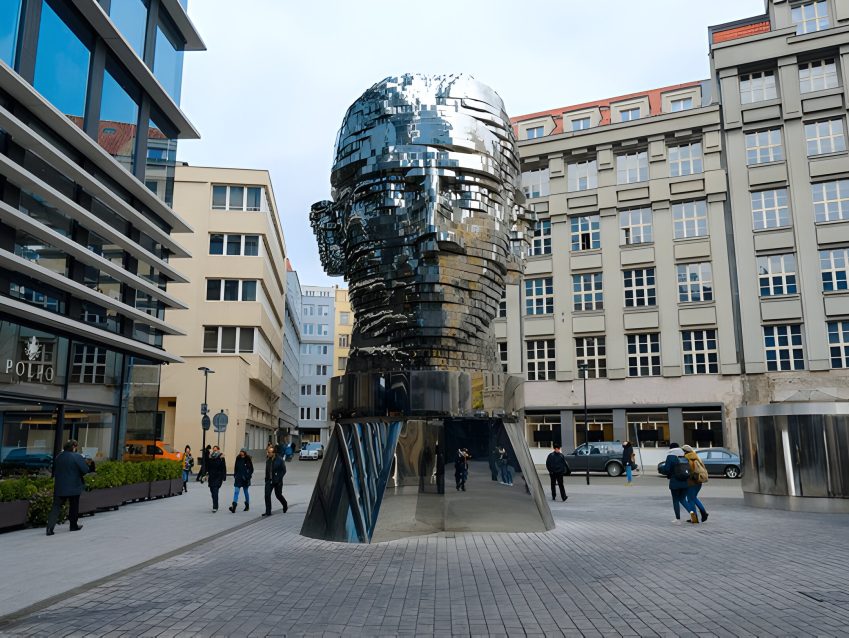
In the heart of Prague, behind the Quadrio shopping center in the courtyard, stands a striking and unique creation that captures the essence of one of the 20th century’s most significant literary figures — Franz Kafka. This remarkable installation, known as “Franz Kafka’s Moving Head,” is a fascinating work by contemporary Czech artist David Černý. Completed in 2014, this kinetic sculpture is an ingenious artistic tribute to Kafka. As you approach the installation, you will be greeted by a towering figure made up of forty-two layers of steel plates arranged to form a bust of the inspiring Jewish writer. The head rotates slowly, creating a visually striking effect as it spins continuously, allowing viewers to experience the work from various angles.
One might think that the layers move in different directions perhaps not only for the purpose of the kinetic show, but also to demonstrate that Franz Kafka was a sensitive and reflective man of many facets, not all of which he showed to most people. Similarly, his works are full of multiple layers of meaning, which are revealed to the attentive reader with vivid imagination. In addition, transformation is a recurring theme in Kafka’s work, and it is possible to witness how the head transforms into all kinds of shapes, the world around it being reflected on it, the same way Kafka’s surroundings influenced his works. If you imagine that head as your own, you can easily imagine feeling dizzy, perhaps anxious, perhaps experiencing something like a nightmare or an existential crisis, which is a typical atmosphere you feel in many of his works.
As such, the head functions as a symbol of Kafka’s distinctive legacy. Franz Kafka, born in Prague in 1883, is renowned for his intricate and thought-provoking narratives that delve deep into the human psyche, bureaucracy, and the absurdities of life. His most celebrated works, such as “The Metamorphosis” and “The Trial,” explore themes of alienation and the struggle for identity in an impersonal world. Due to his unique perspective he is regarded as a pioneer of existential and surreal literature.
Kafka spent most of his life in or near Prague’s Jewish Quarter and the Old Town Square. His life experiences in this city profoundly shaped his writings. A stroll through the cobblestone streets in the dark in the areas where he lived might help you understand the melancholy expressed in his works. A visit to Franz Kafka Museum in the Lesser Quarter (behind the Streams/the Pissing Sculpture by David Černý), will provide a valuable insight into his world, and how he grappled with his identity amid the pressures of family and society.
Fans of Kafka will also be interested in the other sculpture of Kafka in front of the Spanish Synagogue in the Jewish Quarter, Vězeňská Street. Jaroslav Róna created the piece in 2003 and named it simply Franz Kafka’s Sculpture. It depicts Kafka riding on the shoulders of a headless figure, in reference to the author’s story The Description of a Struggle. In addition, Franz Kafka’s Head is very close to the Spitfire Butterfies moving sculptures (see below).
David Černý is a renowned Czech artist best known for his thought-provoking and often controversial sculptures. Born in Prague in 1967, Černý has made a significant impact on the contemporary art scene both in the Czech Republic and internationally. His works frequently challenge societal norms, political subjects, and historical narratives, making him a major figure in modern art. Following his studies at the Academy of Art, Architecture, and Design in Prague (UMPRUM), he quickly established a reputation as a daring artist willing to challenge stereotypes and question authority through art.
He gained further international recognition after creating his sculpture called “Entropa” for the Czech Republic’s presidency of the European Union (2009; now located at the Techmania Science Centre in Pilsen). It challenges stereotypes about European countries and encourages both humorous and critical interpretations. David Černý is an innovative artist who has a way of keeping himself consistently visible, and succeeds in installing new sculptures throughout the country without relying on European or state funds. You can explore his works at various locations, including his gallery called Musoleum (near Praha-Smíchov train station), and occasional temporary exhibitions.
The following are David Černý‘s other best-known sculptures in the centre of Prague:
Saint Wenceslas, 1999 (Lucerna, Vodičkova Street).
The Streams (2004), also called the Peeing or the Pissing Sculpture (in the courtyard of the Kafka Museum).
Spitfire Butterflies, 2024 (Máj, Narodni Avenue, near Franz Kafka’s Head). It is composed of two butterflies in constant motion, perhaps to symbolise the delicate balance between war (planes) and peace (fragile butterflies). An ingenious concept, given that the name of the shopping centre was Máj long before the two spring butterflies landed on it, and Prague was liberated by the Soviet Army in May 1945, which is a month in the spring. In addition, the planes might remind us of the free WW2 Anthropoid Operation Crypt a few blocks away, many of whose participants had undergone training in Britain in the RAF.
Both butterflies are particularly impressive at night, when they are beautifully illuminated. This makes it an ideal location for a night-time stroll from the butterflies towards the Dancing House, whis also glows in the dark.
Man Hanging Out, 1996 (Husova St near the Old Town Square). Perhaps Sigmund Freud, perhaps an intellectual pondering about the state of this world and our future, juggling the pros and cons of his life and our civilization. Perhaps too much out of this world, like many intellectuals. Surprisingly lifelike at a distance, so some people have sincerely interpreted it as a person in danger, or perhaps about to commit suicide, which is certainly a Freudian topic.
Věra, 2024. (Originally exhibited in Paris during the Olympics, this moving sculpture is now situated behind Tyrš House in Kampa, close to the Lennon Wall.) It pays a tribute to the Czech gymnast Věra Čáslavská, the renowned multiple Olympic medalist who courageously stood up against the Soviet Occupation in 1968.
Lilith, 2022 (Karlín, tram stop Invalidovna). A This sculpture is a twenty-four-metre steel sculpture of a strong woman holding up a block of flats. It could be interpreted as a tribute to the strength of women, who support humankind, men and children.
Babies, 2001. The first set of babies are ten plastic sculptures of babies climbing up the Žižkov TV Tower. The second set consists of three metal babies crawling near the Kampa Museum, a museum of modern art. Finally, there has been one metal baby near Atrium Žižkov since 2020. They all have something like a code instead of a face, which gives them a somewhat eerie and futuristic appearance. According to the author, they are meant to symbolise the pros and cons of technological advances and their impact on people.
Despite the possible interpretations of David Černý’s art above, no interpretation of any of his sculptures is necessarily the right one, as he himself acknowledged. We invite you to formulate your own interpretation.