
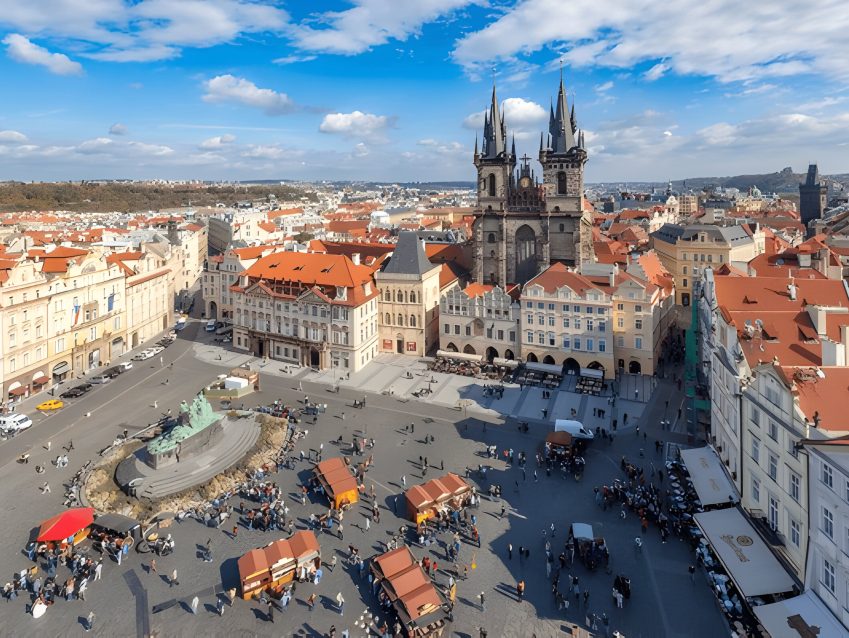
The Old Town Square in Prague is not only one of the most beautiful squares in Europe, but also the oldest in Prague. Every hour, crowds gather in front of the Old Town Hall to watch the apostles march and the skeleton strike the hour on the unique Prague Astronomical Clock. Others relax on benches or restaurants beneath the arches, enjoying the atmosphere of this historic place.
The square has long been a bustling marketplace at the crossroads of European trade routes. Nearby is a picturesque merchants’ courtyard (now called Ungelt), where foreign traders brought their merchandise and celebrated closing deals as early as the 10th century. You can find it behind the sleek Gothic Týn Church, an iconic symbol of the Old Town built mainly by Charles IV in the 14th century. Its twin asymmetrical spires, bristling with dark Gothic spikes, look like something from a fantastical fairy tale.
The famous Astronomical Clock on the tower was made in 1410 at the latest, and it is the oldest still-running astronomical clock in the world. The Old Town Hall also consists of the other colourful buildings to the left of the tower, a colourful patchwork acquired over centuries. The panoramic view from the tower is arguably the best in the Old Town, even better than that from the terrace of the U Prince restaurant. From this vantage point, the red roofs of the Old Town unfold like a map, leading to Charles Bridge and Prague Castle beyond.
Apart from the Old Town Hall and the Church of Our Lady before Týn, the square is also dominated by the Baroque Church of St. Nicholas, the Rococo Kinsky Palace (now the National Gallery), and the neighbouring House at the Stone Bell. Originally a Gothic royal palace from the 14th century, it is now part of the Prague City Gallery (temporary exhibitions only). Despite the stylistic diversity, the square appears remarkably harmonious.
The Old Town Square is the oldest market place, probably dating to the 10th century. From the 12th century onwards, the market and its access roads were surrounded by stone houses. The ground floors of these houses are mostly preserved in the cellars of today’s buildings (e.g. Black Angel’s Bar) because the terrain around the Old Town Hall was later raised to protect it from frequent flooding. After all, it is located only a ten-minute walk from Rudolfinum right by the river.
The square was primarily a daily marketplace, but it also hosted knight tournaments, celebrations of all kinds, pilgrimages, circus performances, and other events. The square has witnessed many historical events that have affected the entire country, both famous and tragic. Battles were fought here, royal announcements made, and people punished. Luckily, only demonstrations, parades and cultural events are held in the square today.
To remind us of important 15th-century events, the large Art-Nouveau sculpture (1915) of Master Jan Hus dominates the square. This influential Protestant church reformer was burnt at stake in Germany, which sparkled twenty years of Protestant-Catholic clashes in the country, the Hussite Wars. Defiant even in death, he is surrounded by his followers and a grieving mother symbolising the rebirth of the nation. Jan Hus was a major inspiration for Martin Luther and became a potent symbol of Czech resistance in a country that has so often fought for its identity.
In addition, the twenty-eight crosses painted on the cobblestones near the Old Town Hall Tower remind us of another period of Protestant and Catholic clashes in the 17th century. It was the site of the execution of twenty-eight Czech Protestants in the 17th century (twenty-seven plus one dead body of a prisoner executed nevertheless). The execution took place after the Czech Protestants lost a major battle, as punishment for their rebellion against the Habsburg emperor. They had even dared to defenestrate two deputies to the king and their assistant at Prague Castle, where you can still see the window. This act sparkled the fateful Thirty Years’ War across much of Central and Northern Europe. Following the battle, thousands of Czechs were forced to either convert to Catholicism or leave their country. The Czech Kingdom remained part of the Austro-Hungarian Habsburg Empire for another three hundred years, until Czechoslovakia was finally established in 1918.
Fortunately, the country has experienced greater religious tolerance since the fall of the Communist regime in 1989. One symbol of this is the Marian Column, a Catholic monument only erected in 2020. For some still a negative symbol (forced re-Catholicisation and Habsburg oppression), for most simply a beautiful monument that belongs there, since the 17th-century original was torn down by a jubilant mob in 1918.
The Old Town Square is a splendid architectural space and a living textbook. If you come here at night, you may also be able to sense the spirit of Franz Kafka‘s haunting the square and the nearby Jewish Quarter. The famous Jewish writer from Prague was born just around the corner in a house on Franz Kafka Square and lived at various addresses around the square. You can picture him meeting Albert Einstein or Max Brod at the former literary café/cultural salon in the building at number seventeen. Walking here is like walking in the footsteps of many influential minds. Every cobblestone seems to whisper tales.