
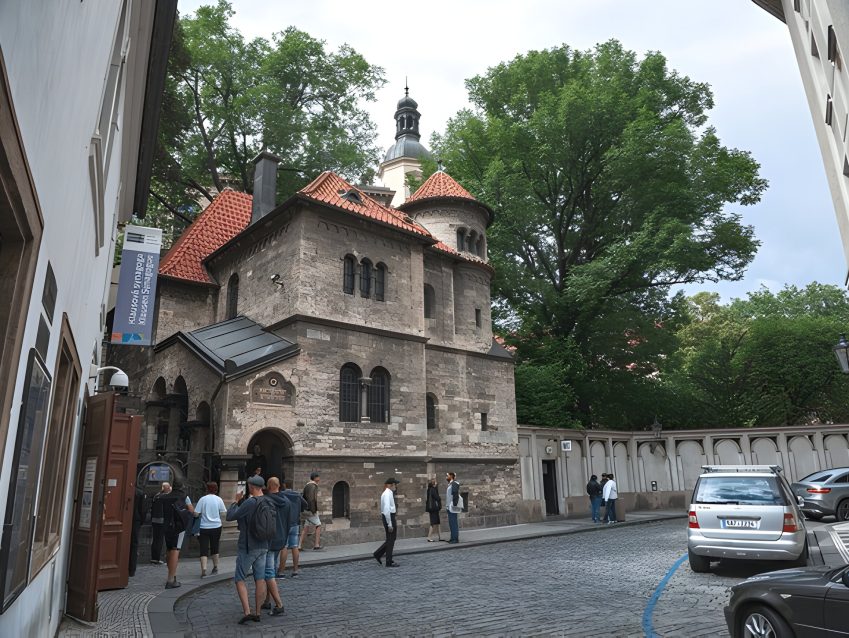
Prague’s Jewish Quarter, also called Josefov, is nestled within the heart of the Old Town. To walk its streets is to traverse a thousand years of Jewish life in Europe — from a thriving medieval ghetto to a site of unimaginable loss. Even though the houses where the Jews lived in the Jewish Ghetto were demolished in the 19th and early 20th century during a questionable redevelopment project, several unique synagogues have been preserved, as well as the Old Jewish Cemetery. The synagogues are living museums now, the cemetery looks like is a forest of stones, and the haunting shadows of Golem, Franz Kafka’s Jewish Prague and the Holocaust whisper their tales wherever you go, perhaps even more so when it gets dark.
The Jews are known to have lived in Prague since at least the 10th century. The oldest preserved synagogue, the Old-New Synagogue, was built in the 13th century, which is when they relocated there from their previous settlements in Prague. The remarkably preserved synagogue is actually Europe’s oldest active synagogue. Stepping inside is like entering the Middle Ages; the interior is low-vaulted, dark, and austere, with its central bimah (pulpit) from which the Torah is read. It served as a prayer hall, public meeting place, rabbi’s office, and school. This is the synagogue where Rabbi Loew prayed, and it is also linked to the most famous of all Prague legends: the story of Golem.
According to the legend, in the 16th century, Rabbi Loew created a giant from the clay of the Vltava River to help and protect the Jewish community. He brought the creature to life by placing a shem (a holy name of God) in its mouth. The Golem performed its duties, but grew violent and uncontrollable after not having been given enough rest. The Rabbi was forced to deactivate it, hiding the body in the attic of the Old-New Synagogue, where it is said to remain to this day (the attic is sealed and inaccessible). Other versions of the legends claim that Golem was simply disassembled because he was no longer needed. In any case, the legend lives on, and you will find him in souvenir shops and names of shops and restaurants in the neighbourhood.
The rabbi himself (Rabbi Judah Loew ben Bezalel, or the Maharal of Prague) is buried in the Old Jewish Cemetery, together with other prominent Jewish personalities. He was a respected scholar and philosopher. It is on his grave that you will find so many small pebbles left by visitors, on top of scraps of paper containing prayers or positive messages (Jewish tradition). The cemetery is truly unique worldwide because of the number of bodies buried there. Used from the 15th century until the 18th century, it is like a silent crowded city of the dead. Due to lack of space and the Jewish tradition of not disturbing old graves, layers of soil were piled atop existing graves, resulting in about ten layers (only an estimate) and the characteristic jumble of nearly twelve thousand tombstones. The reason is simple: the Jews were not allowed to live anywhere else but in the enclosed area of the Jewish ghetto, and therefore not to bury anywhere else either.
Over the centuries, the Jewish Quarter experienced ups and downs, faced pogroms and looting, was nearly wiped out by several outbreaks of plague, ravaged by destructive fires and regular floods. This area was lower than many other areas in Prague, so floods very more common and typically more devastating.
During the better times it was a very lively and vibrant neighbourhood, often considered the most important commercial centre of old Prague. One of its best times were probably during the reign of Rudolf II (16th c.). The Habsburg emperor confirmed Jewish privileges, and the Jewish town is said to have flourished as never before. At that time, the Maisel, Pinkas, and High Synagogue were constructed, as well as the Town Hall and many other private and public buildings. Apart from the Pinkas Synagogue, they were all built by another important Jewish personality, Mordechai Maisel, who was the head of the Jewish community as well the court Jew of Rudolph II.
Many rulers valued the Jews also as a source of tax revenue, and even borrowed money from them, whereas others expelled them, for example Maria Theresa in the 18th century. Luckily, her son Josef II, after whom the neighbourhood is called, gave them more freedom and rights. Later, the Jews were even allowed to leave the poor and cramped neighbourhood as it was no longer an enclosed area. Many Jews who could afford it left, and it became mainly a poor neighbourhood, not a predominantly Jewish neighbourhood.
The quarter as we see it today is largely a 19th-century or early 20th century creation, apart from the cemetery and the synagogues mentioned above. The local authorities demolished much of the poverty-stricken but culturally rich ghetto. The crooked alleys were replaced by the broad, elegant boulevard of Paris Street (Pařížská Street) and other streets, with many new beautiful blocks of flats built. Unfortunately, a number of rare buildings, including three ancient synagogues, fell victim to this redevelopment. Almost 500 houses disappeared, but luckily, six synagogues, the Old Jewish Cemetery, and the Old Jewish Town Hall were spared, clustered together as a stark reminder of what was lost.
While standing in front of the unique Old-New Synagogue, you will notice the two clock faces of the Jewish Town Hall, built in the 16th century, but rebuilt in the Baroque style in the 17th and 18th centuries. One of the clock faces is a rare Hebrew clock, with Hebrew symbols going from right to left, a curiosity created this way for an unknown reason; the creator was not a Jew, and the clock was a present. Next to the Town Hall, you will see the beige High Synagogue, which is not accessible to the public and remains the most commonly used synagogue for church services by Prague’s Jewish community.
If you continue along the street opposite the Old-New Synagogue, adjacent to the cemetery, you will see the Baroque Klausen Synagogue from the 17th century, which houses an exhibition focusing mainly on Jewish customs and traditions. It was also home to Prague’s Jewish Funeral Brotherhood. At the beginning of the 20th century, the Neo-Romanesque Ceremonial Hall next to it was used for the same purpose, i. e. rituals related to death and burial. Now it contains especially exhibits related to the social life and medical practices of the Jewish community.
Farther away from the Town Hall, in the same street, you will be able to appreciate the Maisel Synagogue, Maisel Street. Named after the above-mentioned wealthy mayor, it was largely rebuilt in the Neo-Gothic style (19th/early 20th c) and hosts an exhibition on the history of the Jews in the Czech lands until the 18th century, showcasing remarkable artifacts like Torah scrolls and silverwork.
However, we still have not mentioned the two synagogues that are the most stunning in terms of interiors. The first one, the Spanish Synagogue, is in the Jewish Quarter, a five-minute walk from the Old-New Synagogue or the Old Town Square. If you keep walking back along Paris Street, you will find it if you turn left, standing behind the well-known sculpture of Franz Kafka. This synagogue is an explosion of golden Oriental opulence inside. Built in the 19th century in the Spanish Moorish style, its interior is a breathtaking fantasy of gilded stucco and stained glass. The exhibition continues the historical narrative from the Maisel Synagogue, covering emancipation, the Holocaust, and the post-war period. However, if you do not want to see the whole of the Jewish Museum, you can appreciate its beauty during a concert of classical music, held several times every week.
In addition, it is highly recommended that you visit the other synagogue with the most breathtaking interior, the Jerusalem Synagogue (also called the Jubilee Synagogue). Not in the Jewish Quarter and therefore often overlooked, this gem stands in a street near the main train station and Wenceslas Square. Built at the very beginning of the 20th century, it offers a fusion of Moorish and Art-Nouveau styles, its colourful facade shining like a star. This is the ideal option for budget travellers, or those who would find reading about the Holocaust in the other synagogues too hard to bear. Luckily, this synagogue is accessible separately from the other synagogues that are part of the ticket to the Jewish Museum. However, if you have already visited the museum and present your ticket there, you can purchase a discounted ticket to the Jerusalem Synagogue. The exhibition focuses on its construction, and especially the persecution of the Jews during the Communist era (1948-1989).
Finally, the Pinkas Synagogue needs to be mentioned here, but we do not recommend that you finish your visit to the Jewish Museum with it, because it is the most emotionally devastating. Since the 1950s, its walls have been inscribed with the names, birth dates, and last known dates of almost 80,000 Czech Jewish victims of the Holocaust. The sheer scale is overwhelming; the names cover every surface, rising from floor to ceiling. Upstairs, a haunting exhibition displays drawings made by children imprisoned in the Terezín (Theresienstadt) camp before they were deported to their tragic deaths in Auschwitz or elsewhere. The synagogue is a silent scream of loss, a deeply moving memorial that personalizes the immense tragedy. Built in the 16th century, it is a mixture of Gothic, Renaissance and Baroque architectural styles. Only in the 1960s was a unique historical mikvah (ritual bath) discovered in the basement of the building next to the synagogue (16th c.)! It is still in use today by Prague‘s Jewish community and Jewish travellers.
You can learn more about Jewish Prague and WW2 in Prague elsewhere on this website.