
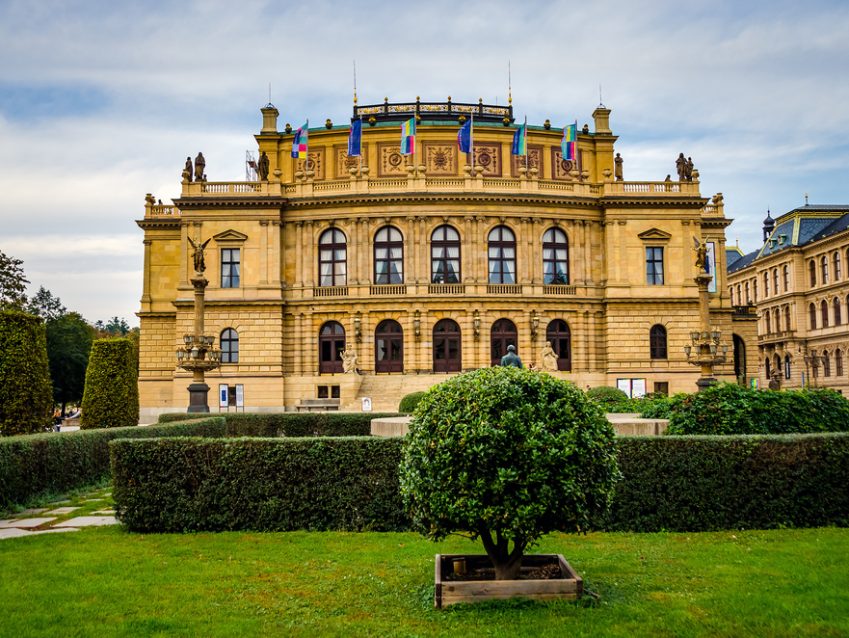
Rudolfinum is located in the picturesque heart of Prague along the banks of the Vltava River, offering breathtaking views of Prague Castle. It is only a ten-minute walk from the Old Town Square, or a fifteen-minute walk from Charles Bridge, Lesser Quarter.
It is an outstanding architectural marvel that serves as a vital cultural hub for the Czech Republic. It contains a stunning concert hall and is home to the Czech Philharmonic Orchestra. It also serves as a venue for significant cultural events, such as Czech theatre, film, or music award ceremonies. Last but not least, it includes a free gallery of modern art and a café.
This multi-purpose building was opened in the late 19th century and named in honour of the Austrian Crown Prince Rudolf, who also visited it. Its interior and exterior are both impressive because its construction was funded by a prosperous Czech savings bank during the times of the Austro-Hungarian Empire. It was constructed in the Neo-Renaissance style by renowned Czech architects who had also designed the National Theatre by the river. Josef Zítek and Josef Schulz had travelled extensively to study leading concert halls around Europe, ensuring that the design met contemporary standards.
One of the key attractions of Rudolfinum is certainly its architectural elegance. The building’s exterior boasts grand staircases, adorned with intricate sculptures and decorative elements, such as sphinxes, lions, and muses. The hall is decorated with frescoes and lavish chandeliers. Not surprisingly, Rudolfinum has also featured in many films and TV series. For instance Amadeus, The Gray Man, Spiderman, Carnival Row, The Witcher, or The Genius (a TV series about Albert Einstein, who taught in Prague for over a year).
The Dvořák Hall is the primary concert venue for up to 1,200 guests, while the smaller Suk Hall can seat about 200 people. There is also a sculpture of Antonín Dvořák in front of Rudolfinum, and rightly so. Dvořák worked in the building as the first conductor of the Czech Philharmonic Orchestra, including its first performance in 1896 (Dvořák‘s Slavonic Rhapsody, Biblical Songs, and the world-famous 9th Symphony From the New World, whose tunes sound familiar even to those who are not particularly interested in classical music).
If not to listen to a concert, you should at least see the building inside to admire the stunning interior. You can visit the café, or the free gallery of modern art, if its temporary exhibition seems appealing to you. Its rotating exhibitions often include thought-provoking installations, photography, paintings, and multimedia displays.
Although Rudolfinum was built as a venue for music and art, it has also been used for other purposes over the years, mirroring the dramatic history of the Czech nation. It served as an infirmary for soldiers during WW1, and even the seat of the Czech National Assembly (Parliament) during the First Czechoslovak Republic, from 1920 until 1939. During WW2 it became a music venue again after a significant reconstruction. This time for the German Philharmonic Orchestra, showcasing German music attended by German intellectuals as well as Nazi politicians. It was inaugurated in 1941 by Reinhard Heidrich himself, the acting Reich Protector of Bohemia and Moravia. Following WW2, the first ever concert of the Prague Spring music festival was held there (1946). Unfortunately, later the building was neglected by the Communist government; part of it was even used as a gym. It only underwent an extensive renovation in the 1990s, after the Velvet Revolution.
Whether you choose to attend a concert, explore an art exhibition, or simply stroll around the beautiful exterior, Rudolfinum promises a memorable experience.