
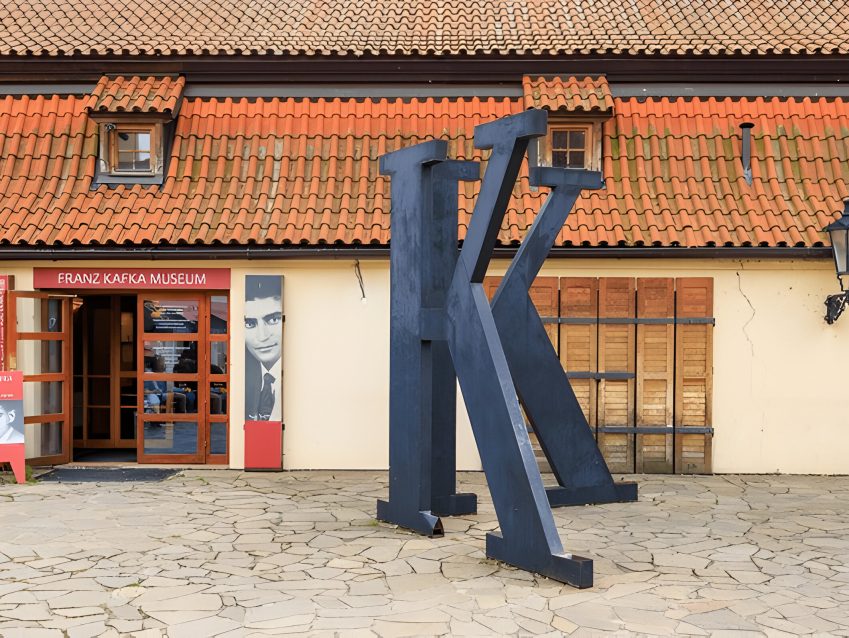
Kafka spent most of his life in or near Prague’s Jewish Quarter and the Old Town Square. His life experiences in this city profoundly shaped his writings. A stroll through the cobblestone streets in the dark in the areas where he lived might help you understand the melancholy expressed in his works. A visit to Franz Kafka’s Museum in the Lesser Quarter (behind the Streams/the Peeing Sculpture by David Černý), will provide a valuable insight into his world, and how he grappled with his identity amid the pressures of family and society. Located on the picturesque bank of the Vltava River near Charles Bridge and the Narrowest Alley, the museum is an essential destination for literature enthusiasts, history buffs, and those intrigued by the complexities of human existence as reflected in Kafka’s works.
Franz Kafka Museum offers a fascinating glimpse into the life of this gifted Jewish writer. It is dedicated to preserving and promoting his legacy, showcasing a comprehensive collection of manuscripts, letters, diaries, and photographs that evoke the atmosphere of Kafka’s life and the themes he explored in his literature. Visitors can stroll through the exhibits that showcase Kafka’s most renowned works, such as “The Metamorphosis,” “The Trial,” and “The Castle,” but also provide context for his personal experiences and struggles with identity, alienation, and existentialism.
The museum’s design is as thought-provoking as Kafka’s writing itself. A notable feature is the collection of original manuscripts and first editions that exemplify Kafka’s unique style and themes. For instance, the haunting illustrations and excerpts from “The Metamorphosis” poignantly represent the protagonist Gregor Samsa’s transformation into a giant insect, echoing Kafka’s exploration of human disconnection and anxiety. The reflective spaces encourage contemplation, inviting visitors to immerse themselves in the emotional and psychological landscapes portrayed in his writings.
To fully appreciate Kafka’s legacy, it is essential to understand the city that shaped him. The museum also provides insights into Prague’s Jewish heritage, highlighting Kafka’s own background and how it influenced his work.
The building that houses the museum has no known connection to Kafka’s life, although it is likely that he walked along this bank of the Vltava many times. It was originally a brickyard, constructed in the Baroque style in the 18th century and rebuilt in the 19th century in the classical style. At the beginning of the 20th century, the production of bricks at this site was discontinued. The buildings were subsequently used solely as a warehouse and a garage for historic carriages. During the period of Communism (1948-1989), the building fell into disrepair. In 2002, it suffered damage in a major flood. The museum was opened in 2005 and the property is owned by the municipality.
The sculpture you will see in front of the museum is not related to Kafka. It is called The Streams (2004), the Peeing or the Pissing Sculpture.
If you are a Kafka fan, you should also see two sculptures in Prague inspired by Kafka located elsewhere:
Franz Kafka’s Head, 2014 (Quadrio, Narodni Avenue) and Franz Kafka’s Sculpture in the Jewish Quarter by Jaroslav Róna (2003). It is located in front of the Spanish Synagogue and depicts Kafka riding on the shoulder of a headless figure, in reference to the author’s story “The Description of a Struggle“.