
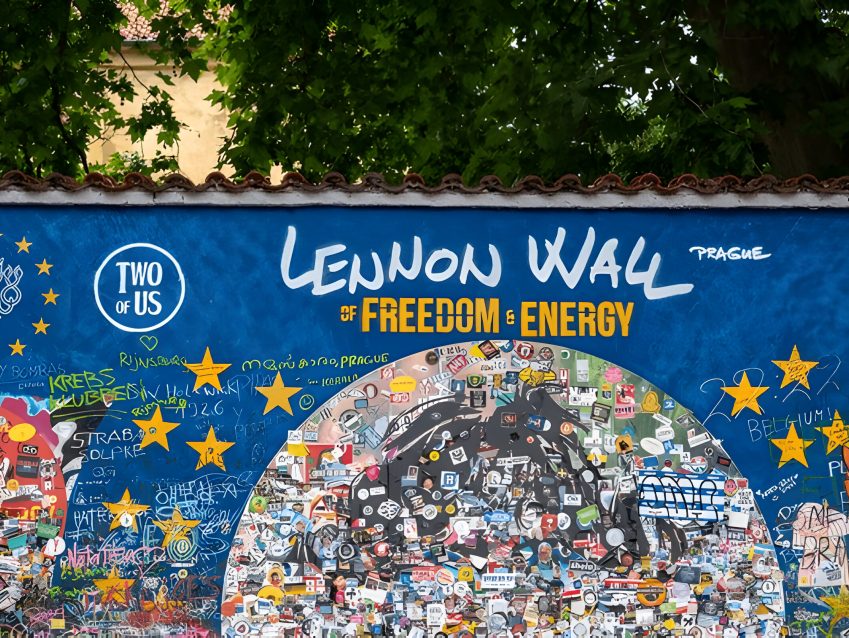
The tradition of writing on the wall now known as the Lennon Wall dates back to at least the early 1960s. Originally, it was not connected with Lennon at all. Some people used to write poetry and other messages there. Only later did anti-establishment graffiti appear.
Following the fateful Soviet occupation of 1968, which was intended to supress the Prague Spring, more protest slogans against the occupation and the totalitarian communist regime frequently emerged.Therefore, some people started calling the wall the “Wailing Wall“.
Soon after John Lennon’s death in 1980, someone had the idea of using a niche in the wall to create a fictional gravestone in his memory using a stone lid and chalk. “For John Lennon” was written there, with a cross above. The wall thus acquired the name Lennon(‘s) Wall, although Lennon had never visited the area, unlike his ex-wife Yoko Ono later. Many people started bringing candles and flowers to the “grave”, and lyrics from Beatles‘ songs appeared on the wall, alongside other messages, pictures and newspaper clippings.
The first rally after Lennon’s death, on the one-year anniversary in December 1981, was completely peaceful and dignified, with a deeply spiritual atmosphere of people humming his songs and speaking quietly. However, the police disliked even such peaceful gatherings, neither did they like those protest signs on the wall. They would keep repainting it, even stationing cameras and over-night guards at the wall to prevent further attempts. To their frustration, all such measures were ultimately fruitless. Each time the wall was painted over, it only provoked more and more protest signs. Gradually, the commemorative meetings turned into larger demonstrations due to police intervention. These spread beyond the square near the wall, foreshadowing the street demonstrations of the late 1980s that would lead to the Velvet Revolution in 1989.
The largest rally took place in 1984, with at least 400 people gathering near the wall. The police dispersed the crowd by driving cars into them, using batons and unleashed dogs. The liberalization movement was sometimes described by the Communists in the media as “Lennonism” (not to be confused with “Leninism”!), and its participants were labelled as alcoholics, sociopaths, mentally deranged people, and even agents of the Western free-market capitalism. To prevent people from writing on the wall, the Communist government finally placed a poster board on the wall, which remained there until 1990.
After the Velvet Revolution the wall and the monastery behind it were returned to the Order of the Knights of Malta. They commissioned a Czech painter to create a portrait of John Lennon on the wall, but even that only lasted for about two months. The wall continued to evolve organically, regardless of any official efforts and regulations even after the revolution.
The last significant “official” repainting of the entire wall took place in 2021, when 29 young European artists were invited to decorate it with slogans related not only to freedom and peace, but also environmental protection as part of the “Wall of Freedom and Energy” project during the Czech EU Presidency. One of the pictures that is still currently visible is a portrait of the inventor Tesla, for example. In the central part, a large circular mirror with another portrait of Lennon was installed to reflect the images of people standing in front of the wall, making all visitors part of the artwork. Nevertheless, the mirror is now barely visible as it is mostly covered in stickers.
The John Lennon Wall has evolved into a canvas for artistic expression and dissent, reflecting the collective aspirations of a generation yearning for freedom, and political and social change. It continues to serve as a poignant symbol of peace, love, and resistance to oppression. The ever-changing layers of graffiti, artwork and messages on it demonstrate how art can foster dialogue and change. Other walls inspired by the Lennon Wall in Prague have been built abroad, for example several in China, later torn down by the government.
The Order no longer guards the wall to prevent new messages being written on it. However, marking the wall is only permitted in the designated white zones using impermanent materials that will wash off, such as pencils, markers, or chalk (spraying is forbidden). Busking near the wall is not allowed.
Those who want to learn more and experience the spirit of the dramatic times during the Communist regime can visit the Museum of the Lennon Wall behind the wall. They will also see photos and a documentary featuring witness accounts, as well as historic objects and Beatles memorabilia.
You can also take shelter behind the wall, under one of Prague’s oldest and tallest trees (cca 300 years; 33 m), where Beethoven used to rest when he was young and in love (Beethoven’s Tree). The wall is very close to Charles Bridge, the Narrowest Alley in Prague, or Franz Kafka Museum. You will also be able to see the picturesque Prague Venice canal (Devil’s Canal) from a footbridge near the wall. If you like visiting churches, the Infant Baby Jesus church (Church of Our Lady Victorious) is very close, and St Nicholas Church in the Lessor Quarter not far either.