
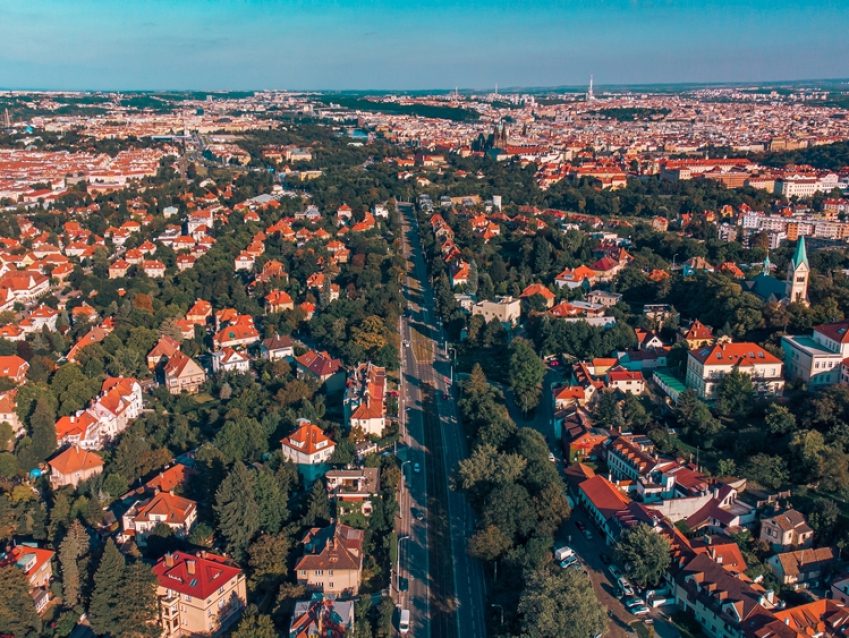
There are many beautiful residential areas in Prague that people call Prague‘s Beverly Hills, but Střešovice is one of the most common. It is one of Prague’s wealthiest districts, characterised by charming villas, gardens, and stunning views of the city. It offers a quiet, tranquil atmosphere, away from the hustle and bustle of the city centre.
Many artists settled in the Střešovice villa district and had their studios there, but even wealthy businessmen and celebrities built or bought their family homes in this pleasant area.
It is known not only for its VIPs and rich inhabitants, but also for its impressive residential architecture, with many charming villas from the 19th and early 20th centuries. Walking or riding through the streets offers a charming glimpse of Prague’s architectural diversity, yet with a pleasant small-town feel, despite its short distance from very touristy areas such as Prague Castle. No wonder even Václav Havel, the former democratic President of the Czech (and Slovak) Republic, decided to live there after decades in the busy city centre.
Although the settlement of Střešovice might seem quite recent, it is much older. Historians know that from the 10th to the 12th c. it belonged to Czech dukes and kings, but later for centuries to the nearby Strahov Monastery. In the 19th century the Premonstratensian monks also initiated the famous local landmark to be built, St. Norbert’s Church, bearing the name of their patron saint, buried at Strahov. The church in Střešovice is much smaller than the monastery, but it stands on a high plateau above the village and dominates the whole area. It is built in the ornate Neo-Romanesque style, and complemented by a cute belfry nearby.
Despite its long history, Střešovice remained a small village until the 1920s, when construction began on the “Ořechovka” area on the site of its former gardens. Originally a separate village, it was absorbed into Prague in the late 19th century and has retained a more relaxed, suburban feel compared to some other parts of the city.
Apart from the aforementioned monastery, visitors can also explore the budget-friendly Museum of Public Transport in the neighbourhood, which is very popular with locals. It boasts a collection of around forty trams, buses, and trolleybuses, offering visitors the chance to learn about the history of municipal transport in Prague first-hand; including the era when trams were pulled by horses!
As well as Petřín Park near the monastery, Střešovice is close to several other parks, such as Hvězda Park and the Royal Garden at Prague Castle. En route to Střešovice, you will most likely pass by a park with an unusual name: Max van der Stoel Park. It is named after the Dutch Minister of Foreign Affairs who was a human rights defender during the communist regime in the Czech and Slovak Socialist Republic in the 1970s. In 1977, he became the first Western politician to publicly endorse Charter 77, a Czech petition co-authored by Václav Havel that called for democracy and human rights in the country. In the park you will see a tree-shaped monument on the ground commemorating the politician and the fight for democracy. There is also a children’s play area, which makes it an ideal place for families with kids to stop after visiting the museum or the Castle.
To complement your trip to Střešovice, you could visit the famous Müller Villa on the way back. Designed by Adolf Loos, a master of blending functuality with simple elegance, this 1930s villa largely influenced other functionalist and modernist architects.
The picturesque district of Střešovice is often overlooked by tourists, making it a perfect destination to explore for those looking to escape the crowds and admire some unique residential architecture surrounded by greenery.