
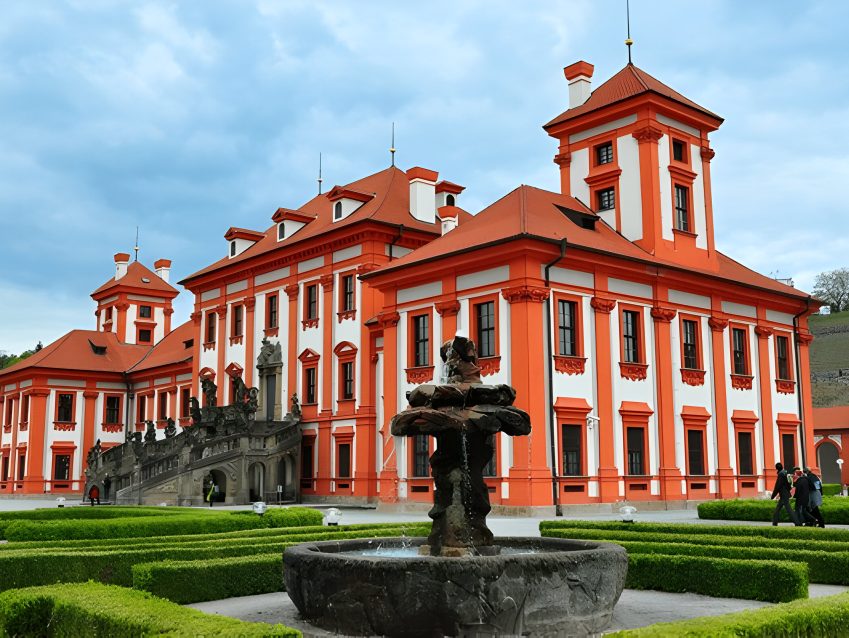
Troja Palace (Troja Chateau) is a masterpiece built in the late 17th century for the Count of Sternberg as a summer residence, designed primarily by J. B. Mathey, the French Baroque genius himself. Inspired by his travels to France and Italy, the Sternberg aristocrat wanted to recreate the elegance and grandeur of the villas and palaces he had admired. Fortunately, modern visitors are able to admire the lavish exteriors of the palace and the vast Baroque garden free of charge.
The geometrically shaped gardens feature beautifully manicured lawns, fountains, statues and richly-decorated staircases, providing the perfect serene escape from the hustle and bustle of the city. The location is also ideal for visitors to Prague who are heading to the city’s zoo, which is directly opposite the palace, or the Botanical Garden, only ten minutes away. The area is a popular destination for cyclists as well, since much of the neighbourhood is a peaceful residential area with abundant greenery. They can make their adventure more pleasant by cycling through Letná Park and Stromovka Park and along the Vltava River. Wine lovers will also appreciate wine from the local vineyards, which only add charm to the whole area.
Unlike most Czech chateaux or castles, the House of Sternberg occupied this summer palace only until the 1920s, when it was purchased by the Czech state. The site was then left unused for a number of years until major reconstruction began in the 1970s. Later, more recent renovations followed suit. Not much of the furniture or other objects have remained in the interiors until now, so the chateau is currently used to house temporary exhibitions of modern art.
However, the primary motivation for most visitors to pay to enter the main building is to admire the spectacular frescoes and stucco decorations throughout, created mainly by Italian and Dutch artists. These are included in the gallery ticket price, and well worth it. Thanks to the murals, the grandeur of the main hall (Habsburg Hall) is undeniable and impossible to resist, although some scenes depict violent battles, boasting the victories of the Habsburgs over the Ottoman Empire. One of the striking features is how plastic the painting pretends to be, including illusionary statues, reliefs, and busts.
A smaller, but equally charming part of the palace are its Chinese-themed rooms, again with exquisite wall and ceiling frescos. Visitors can expect to see a variety of natural wonders, including exotic birds flying over waterfalls and rocky landscapes, as well as temples with distinctive curved roofs. All that adds to the sensation of being transported to a different world.
If your time is limited and you do not have time for the stunning interior walls, the gardens offer an ideal setting for relaxation and romantic photographs. Please take a moment to admire the grand staircase, which faces the large fountain. Its sculptures depict the battle between the Titans and the Olympic vases line the terraces. You will also be rewarded with a view of Prague Castle in the background. All that beauty is easily accessible by public transport, with the journey from the main train station taking approximately 30 minutes by metro and bus (Praha hl. n. to Prague ZOO Praha). For details of connections and e-tickets, please refer to the PID app. This option is ideal for travellers who wish to see a magnificent chateau without having to leave Prague.