
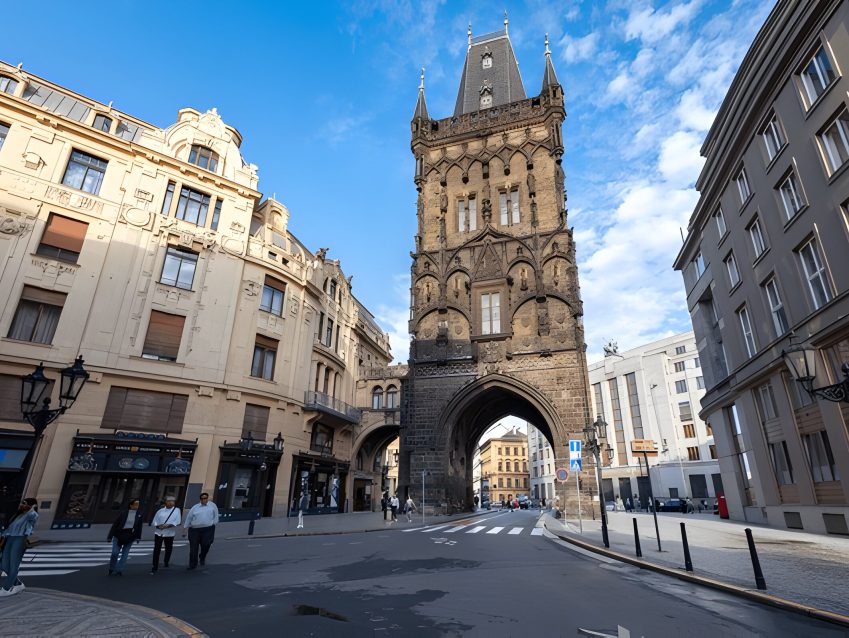
The Powder Gate/The Powder Tower (Prašná brána) is one of Prague’s most iconic landmarks. This towering Gothic structure (15th c.) once served as one of the entrances to the city’s Old Town. A rather impressive entrance, to be precise, as it was originally the beginning of the so-called Royal Route. The Royal Route was the historic route taken by Bohemian kings during their coronation and funeral processions and other important events. Winding through the heart of Prague, it passed landmarks such as the Old Town Square, Charles Street, Charles Bridge, and Prague Castle. Walking along it today, you can feel as though you have stepped back in time, following in the footsteps of as royalty.
When you are looking at the gate from the Square of the Republic, imagine that to the right of the Powder Gate there used to be a palace called the Royal Court Palace, which was connected to the gate. This huge palace was precisely on the site of the current Municipal House and King’s Court Hotel (the beige buildings). It served as the temporary seat of sovereign power for around 100 years from 1380, when King Wenceslas IV (Charles IV’s son) regarded Prague Castle unsuitable for his needs. Some of his successors and noblemen also favoured the palace, also because it was closer to pleasant endeavours they could pursue in the Old Town, some of them in disguise.
Unfortunately, the Royal Court Palace is gone now, as it gradually fell into disrepair and was devastated by fire and later replaced by an army barracks building. However, both the Municipal House and the Royal Court Palace are worthy successors: grand buildings boasting lavish interiors to impress the most demanding clients and travellers. Unfortunately, the Powder Gate faced a similar fate to the palace and remained dilapidated for centuries. When the royal family moved back to the Prague Castle, the top was even left unfinished and neglected for centuries. As a result, rather than being known as the Powder Gate, it became known among locals as the ‘Ragged Gate’. It is thought that it might have been used to store gunpowder in the 17th century, which probably gave it its current name. The gate’s striking Gothic design, complete with intricate stone carvings and decorative elements, was restored and enhanced in the 19th century, along with a brand new roof.
But what happened to those Old Town walls that the Powder Gate used to be part of? The walls that had encircled the medieval city were no longer needed by the 18th century, nor were they fit for defence as weapons had become more advanced. Eventually they were simply demolished. We now regret that decision, but back then the area was not pleasant or safe at all, as the moat was used to dump rubbish and as a shelter for the homeless, as well as for thieves and other unsavoury characters. So, all that remains of the medieval moat is the name of the street: Na příkopě (On the Moat Street). In addition, if you go to the Můstek metro station, you can see part of the moat down in the passageways, as well as a small bridge that used to span it.
In any case, the On the Moat Street helps travellers to orientate themselves more easily and it is wider than the other streets. When walking from the Powder Gate towards Wenceslas Square along this street, you can imagine that the Old Town walls are on your right, so that’s the direction you’re heading in. The New Town is on your left. Once a defensive moat, it is now lined with shops, cafés and historic buildings, making it the perfect place for a leisurely stroll from the Old Town to the New Town.
If you would like to explore the Powder Gate further, you can climb up its 186 steps to the top for views of Prague’s skyline, especially the New Town. However, the best views of the picturesque Old Town Square and the area’s most charming buildings are from the Old Town Hall Clock Tower, which has a lift. Whichever of the towers you choose, remember that tickets are fifty percent cheaper if you come during the first hour after opening (only available on the spot, unlike other regular online tickets).
Before going to Wenceslas Square, we highly recommend taking a break at the Palladium shopping centre, the largest in the area. Above all, try to see at least some of the stunning interiors of the Municipal House (1912) while you’re there. If you’re short on time, peek into the hallway and the café. If you have more time, book a tour of the jaw-dropping upstairs interiors, including the Mayor’s Hall paintings by Alfons Mucha, the Czech founder of Art Nouveau. Attending a concert in the magnificent Smetana Hall is also an experience of a lifetime, surrounded by such grandeur.