
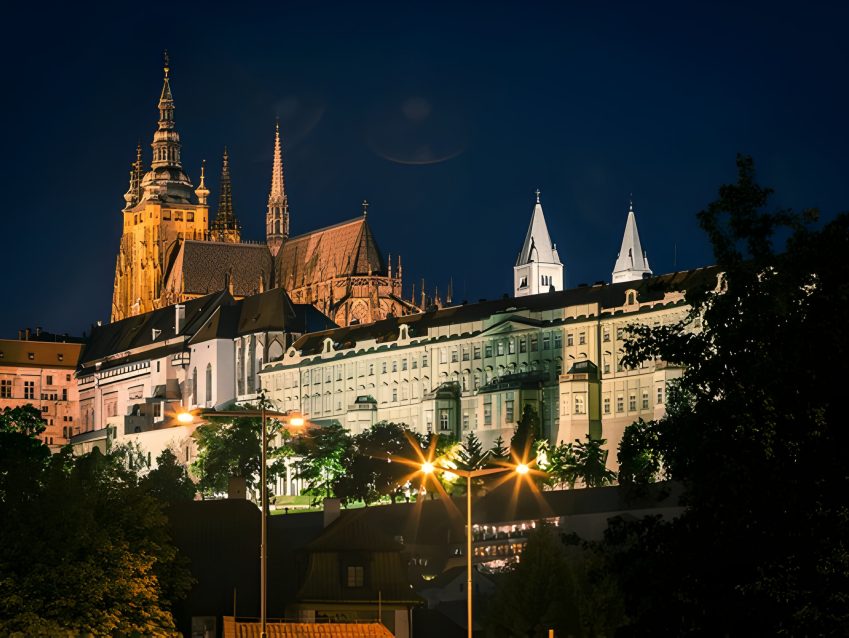
Perched atop a massive hill, overlooking the Vltava River and the sea of red-tiled roofs below, Prague Castle is more than a collection of palaces, towers and churches. It is the heart of the Czech nation and a living chronicle of over one thousand years of history. This is where the Slavic grandparents of Saint Wenceslas established a fortified settlement and a church in the 9th century, the very beginnings of Czech Christianity and Czech statehood. This is the birth of a modern democracy, the working office of Czech(oslovak) presidents since 1918, when Czechoslovakia was established. It is even the largest ancient castle complex in the world according to the Guinness Book of World Records (18 acres).
No structure within the castle walls commands awe quite like St. Vitus Cathedral. King Charles IV intended it to be a coronation church, a royal mausoleum, and a repository for the most sacred relics (14th c.). Several architects contributed to its unique design, including Matthias of Arras (France), Peter Parler (Germany), and an array of Czech architects. Visitors may find it surprising that it was finished almost 600 years later. Its long construction resulted in a unique blend of architectural styles, mainly Gothic and Neo-Gothic. However, one of its spires has a Baroque roof because the previous one had been struck by lightning and rebuilt in the current style (18th c.). When looking at the cathedral from the side, its former southern entrance, the Golden Gate, stands out, a breathtaking 14th-century mosaic of the Last Judgement.
Stepping inside St. Vitus Cathedral, visitors are dazzled by its soaring nave and colourful stained glass windows. The most dazzling chapel is Saint Wenceslas Chapel, with the grave of St. Wenceslas below and walls adorned with semi-precious stones and exquisite golden frescoes. St. Wenceslas actually initiated the construction of the original rotunda for the relics of St Vitus, hence the name of the present cathedral. Another piece of artistic achievement that is impossible to overlook is the Baroque tomb of St. John of Nepomuk (18th c.), the biggest piece of silver in the country. It is the final resting place of the priest whose tortured body was thrown into the Vltava River (14th c.) from Charles Bridge, where his metal sculpture with stars attracts attention. With the exception of one king in the white marble Royal Mausoleum in the middle (Ferdinand I, 16th c.), several other kings and queens are buried beneath St Vitus Cathedral in the Royal Tomb (accessible only several times a day during special tours). There are no separate tickets for visitors who wish to see only St. Vitus Cathedral inside. Only one of the cathedral spires is possible to climb: the Great South Tower (separate ticket, no lift). The interiors of St. Vitus Cathedral are included in the basic circuit ticket. The other three parts of the ticket are: The Old Royal Palace, St. George’s Basilica, and the Golden Lane.
The castle complex is a mosaic of diverse architectural gems, each with its own story. Even though the exteriors and interiors of the Old Royal Palace may seem austere, its interior holds halls that witnessed events which shaped European history. One of the most captivating architectural marvels is the immense Vladislav Hall, built in the 15th century as a masterpiece of Late Gothic and early Renaissance architecture, with a vast rib-vaulted ceiling with no central supporting columns. The hall was designed for grandeur – it hosted banquets, royal meetings, markets, and, most remarkably, knightly tournaments. Today, it is used rarely, only for special occasions such as the inauguration of Czech presidents and the awarding of state honours. Its wing stretching into the Southern Garden also witnessed the famous defenestration of 1618, which ignited a continent-wide war that devastated much of Europe for three decades (Thirty Years‘ War). A group of Protestants threw two Catholic governors and their secretary out of the window. Even though they (miraculously) survived, this event shaped Czech history for centuries. After a lost battle during that bloody conflict, some of the Protestant rebels were executed on the Old Town Square, and Czech Protestants had to either convert, or leave the country.
The church with white spires near the Old Royal Palace is St. George’s Basilica, where the grandmother of Saint Wenceslas and the founder of the Castle is buried (St. Ludmila), together with her son and St. Wenceslas‘ father, Vratislav. Although it contains only remains of the original murals, it is a valuable piece of Romanesque architecture and also the oldest convent in the country (10th century). It is complemented by its colourful Baroque front, with an ornate chapel devoted to St. John of Nepomuk, the main saint used to promote Catholicism after the Thirty Years‘ War in the 17th century.
Walking past the basilica visitors will notice the green-and-white Rosenberg Palace, where mostly temporary exhibitions are held. Then they need to turn left to explore the fourth part of the basic circuit ticket, the Golden Lane. Tucked away behind the castle ramparts, it is a charming, almost fairy-tale street of tiny, colourful houses built right into the castle’s fortification walls. Originally home to the castle’s sharpshooters, legend later claimed it was inhabited by alchemists seeking to make gold for Emperor Rudolf II (16th c.). While this is a myth, the lane did house goldsmiths, hence its name. In the 20th century, it was a poor neighbourhood and a haven for artists and writers. On one of the tiny houses you will notice a sign bearing Franz Kafka’s name. The Jewish writer from Prague frequently visited his sister here and wrote some short stories in the tiny house. Most of the cute houses are now shops and exhibits showcasing medieval and later life as well as arts and crafts. If you pay for the basic circuit ticket, you will be able to see all the displays and shops in the tiny houses, a medieval armoury and the White Tower, a former prison, now displaying also replicas of alchemy tools. Part of the Golden Lane is accessible without tickets after 5 pm in the summer season and 4 pm in the winter season.
After leaving the Golden Lane, visitors can also go down into one of the former prisons and see some medieval torture instruments in the Daliborka Tower (entry part of the basic circuit ticket). Walking towards the viewpoint from the fortification walls, they will also see the oldest visible preserved tower, the Black Tower (12th c.), now no longer black. It was named that way after a massive fire that ravaged the Castle and the Lesser Quarter in the 16th century.
In the warmer season it is highly recommended that you visit both The Royal Garden and Wallenstein Garden (both closed in the colder season). You will find the latter after walking the steps down from the Black Tower and turning right, entering through a gate right next to Malostranská Metro. The Royal Garden, on the other hand, is up in the Castle District, one tram stop away from that station. Located north of the Castle complex, it includes two beautiful sixteenth-century Renaissance palaces that were used for entertainment such as ball games, concerts, feasts and balls: Queen Ann’s Palace (Letohrádek Královny Anny; Summer Palace of Queen Ann) and the Ball Game Hall (Míčovna). The former was also often used by Rudolf II, the Habsburg Holy Roman Emperor (16th and early 17th c.) who was renowned for his interest in occultism, alchemy, art and science. He set up an astronomical observatory on the upper floor, where even Tycho Brahe and Johannes Kepler worked for him. Another less grand building you will see near the Ball Game Hall is the so-called Presidential Villa, a villa where Communist presidents used to live. From the Royal Garden you will also have a better view over several of its remaining towers, as well as remains of the massive fortification system.
Leaving the Royal Garden towards the Stag Moat you will also notice a large beige palace, the Riding School, now an occasional gallery, with free public toilets below. In the warmer season you can go down the Stag Moat to see the Castle from below, surrounded by luscious greenery. You will meet neither deer nor bears there nowadays, but several interesting sculptures. In the warmer season you can also access the Southern Gardens, for example via the Bulls‘ Staircase. From there, the vista over the Lesser Quarter, with the green copula of St. Nicholas‘ Church dominating the foreground, is one of the most photographed places in Prague. If closed in the cold season, you can enjoy incredible views a few steps away outside the Castle complex, near the Titan’s Gate. When leaving the Castle complex through the grand gate, the sculpture of Tomáš Garrigue Masaryk, the first Czechoslovak President (1918-1935), will draw your attention. Please bear in mind that you can only leave the complex through the gate, to enter use the entrance for visitors, left of this imposing gate. It is worth seeing the gate from the square, however, not just from the first courtyard. It depicts Titans (aka Habsburg emperors) killing their enemies as well as small cupids holding the symbols of the state – the Czech lion and the Austrian eagle (18th c.). Near the gate you will also notice buildings that are part of the National Gallery (the beige Salm Palace and the Renaissance Schwarzenberg Palace with sgraffiti decoration). Opposite you will see the white ornate Baroque Archbishop’s Palace, which hides another part of the National Gallery behind, Sternberg Palace.
The exteriors of the Castle are free to explore during the opening hours. The interiors are paid (most visitors buy basic circuit tickets) and accessible with or without a guide. The two best parts of the ticket are St. Vitus Cathedral and the Golden Lane, as described above. However, none of the four parts include chateau-style lavish interiors. If you would rather see that, it is recommended that you visit the Lobkowicz Palace, which you will find behind St. George’s Basilica, on the right. While buildings at the Castle are owned by the state or the Catholic Church, the Lobkowicz Palace (mostly 16-17th c.) is a rare, privately-owned gem within the Castle complex. It is a museum/gallery that displays treasures of the noble family, including original scores by Beethoven and Mozart, masterpieces by Bruegel and Rubens, and an impressive collection of arms and armour. The optional Lobkowicz family-narrated audio guide is part of the ticket. (Please note that the Lobkowicz Palace is not part of the basic circuit ticket). The lavish rooms are also used for frequent concerts of classical music, including Mozart’s masterpieces.
Since the Castle is not a museum frozen in time, but the official office of the President of the Czech Republic, you can also appreciate the Changing of the Guards ceremony. Even though the function of these guards is mostly ceremonial, unlike the other security staff and soldiers, the changing is a popular attraction every day. The “bigger”ceremony with music happens at noon in the First Courtyard (near the Titan’s Gate). The “smaller” ceremonies are on the hour in front of the booths, where the guards swap their places.
It is a truly unforgettable experience to be standing on the spot where saints were buried, wars began, and kings were crowned. Having witnessed so many periods of destruction and development, it is a miracle that so much of Prague Castle has been preserved. Those hundreds of years added layers of immense beauty, making it an amazing blend of architectural styles and a book of a thousand tales. No wonder it is the most visited tourist attraction in the country.
However, your exploration may not finish with the Prague Castle, the whole Castle District (Hradčany) awaits to be explored. Visitors can easily spend the whole day doing that. There are five major galleries inside and outside of the Castle complex (the three parts of the National Gallery mentioned above, the Prague Castle Picture Gallery and the Lobkowicz Palace). Lovers of religious art can also go to the Loretto (Loreta) about ten-minutes away, or at least listen to its unique twenty-seven bells chime on the hour. Those who appreciate Baroque architecture can marvel at the stunning library halls inside the Strahov Monastery complex only fifteen minutes away, where it is also recommended to go for breath-taking views of the whole valley.