
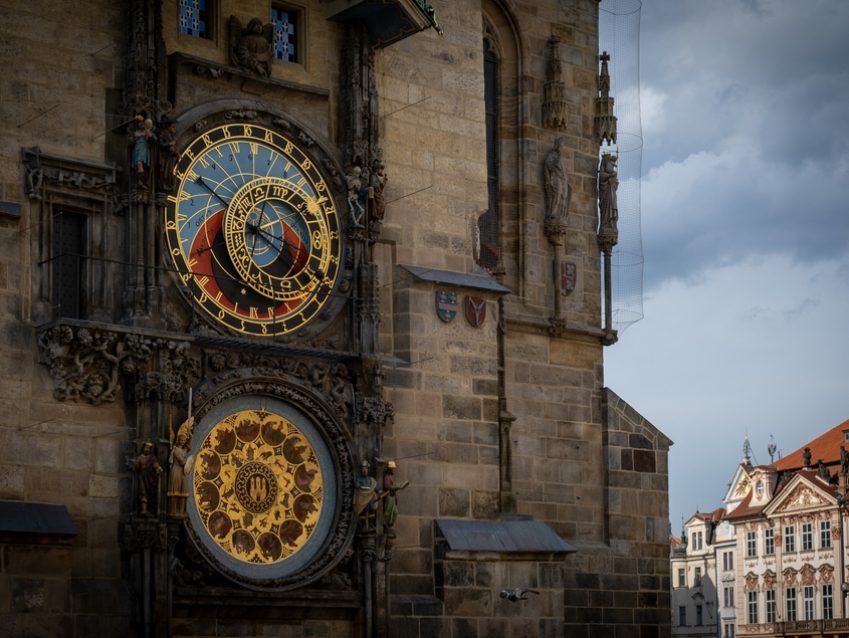
In the centre of Prague’s Old Town in the Old Town Square stands a masterpiece that is more than just a timepiece. The Prague Astronomical Clock (Horologe), known locally as “Orloj“ in Czech, is the oldest still running astronomical clock in the world. It is a complex, mesmerising symbol of science, art, and resilience, captivating millions of visitors who gather beneath its tower every hour to witness a performance that has endured for over six centuries.
Installed at least in 1410 in the Old Town Hall Tower, it was created by two clever minds, clockmaker Mikuláš of Kadaň and Jan Šindel, a professor of mathematics and astronomy at Charles University. It was a monumental achievement of the Late Gothic knowledge and skill. As it was considered so valuable, the local community even developed a legend surrounding its creation. The clock’s creator was allegedly blinded by the Prague Councillors to prevent him from making a similar one elsewhere.
The clock is also a sophisticated astrolabe; something like a medieval astronomical computer. The primary astronomical dial comprises a complex network of wheels and symbols which reveal four types of time. To be able to see our Central European Time, please follow the Roman numerals and the golden hand pointing to the right numeral. In the summer there may be a one-hour discrepancy because it cannot be set to show Summer Time without affecting the integrity of the rest of the display. It also gives us the position of the golden Sun and the black/silver Moon (a black new moon or a silver full moon). In addition, the movable Zodiac ring indicates the month (the location of the Sun on the ecliptic).
Perhaps to satisfy the public’s entertainment needs, the “Walk of the Apostles” was added in the 17th century. Above the clock, two small blue windows open on the hour. As the clock chimes, a mechanical parade of the Twelve Apostles follows. The composition is completed by the presence of four allegorical figures situated beneath the windows, the purpose of which is to provide the assembled crowd with a moral lesson. The concept of vanity is symbolised by a figure admiring himself in a mirror. Greed is depicted as a miser shaking a bag of money. A Turk (or Pagan) is a representation of pleasure and earthly desires, all the things that lure us into self-indulgence and deceive us. (It is sometimes also interpreted as Deception and/or Envy.) The three of them gesture their disapproval to caution us against following their example. Then Death, a skeleton that pulls a rope to ring the bell, nods its head to signify that all of us will face our own death and should behave accordingly. Such reminders of mortality were a common theme in medieval art. The performance concludes with the crowing of a golden cockerel, a symbol of life that chases away the darkness, accompanied by the striking of the hour. (According to legend, ghosts and devils flee at the rooster’s crowing in the morning.) The clock mechanism is discreetly located within the stone tower. Until the end of WW2, it was wound using a crank mechanism. Subsequently, it was connected to an electric motor.
Below the upper dial, you will see the golden lower dial. It is a calendar plate adorned with beautiful paintings of the months and rural Czech life. The sculpture of the Angel previously indicated the right month, and the other sculptures represent good and educated people, so potentially virtues: a philosopher/scholar, a chronicler and an astronomer.
The Orloj’s history is as dramatic as its display. It has withstood wars, fires and almost complete destruction. The most significant damage occurred in the final days of WW2. On 5 May, 1945, during the Prague Uprising, the Old Town Hall was targeted by Nazi artillery fire. The building was severely damaged, and the clock was almost destroyed, except its metal parts. The wooden sculptures of the Apostles and the astronomical dial were almost completely destroyed. Master clockmakers, woodcarvers, and blacksmiths spent three years in a painstaking reconstruction. Using original blueprints dating back to the 1860s and historical photos, they meticulously recreated the clock faces and sculptures. Fortunately, the lower golden dial was already a replica when it burnt, so the more valuable original from the 19th-century is still preserved in the Prague City Museum. Unfortunately, the majority of the 19th-century building burnt down too, so now there are only trees there, and the remains (the red building) now serve as a memento.
It is highly recommended that you also visit the Old Town Hall Tower. You have the option of taking the elevator (all the way) to the top, or climbing (some of) the steps (lower price applies to this option). You will be rewarded with the most breathtaking panoramic view of the square below and beyond. You are higher than the rooftop terrace of the U Prince Restaurant, so you see the whole square and farther away. To take advantage of the early bird discount, please come within the first hour after they open. If you also take a tour of the Old Town Hall interior, which includes a section of the medieval underground, a reduced rate will apply. Discounted tickets to the view tower are only available at the site on the day, while other tickets can be booked online. The buildings have a rich history. They have served as offices, the seat of the Mayor, and a medieval archive. Today, the building is primarily used for tourism (it houses the largest tourist office in Prague) and weddings, with some official events held on a limited basis.
If you would prefer a quieter environment for the clock show, come in the early morning before the first show (usually 9 am to 11 pm). Nevertheless, to fully appreciate the intricacies of the clock, it is recommended that you observe the show more than once. However brief the show is, it is an unmissable spectacle that delights audiences, especially if they know the history behind it.